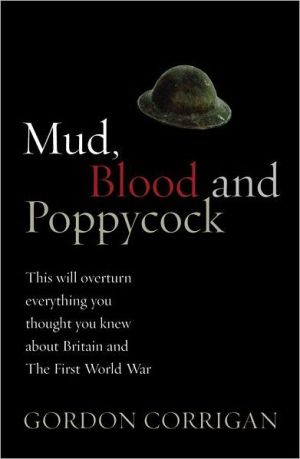
Mud, Blood and Poppycock: This Will Overturn Everything You Thought You Knew about Britain and The First World War (Cassell Military Paperbacks)
Corrigan, Gordon
The First World War was a unique experience for the United Kingdom: the only time Britain fielded a mass army that opposed the main enemy in the primary theatre of war. One consequence of this 'continental commitment' was that Britain suffered many more casualties in 1914-18 than in the Second World War, a factor that has coloured post-1945 attitudes to 'the Great War'. Yet, as Gordon Corrigan reveals, the First World War was neither unnecessary nor badly conducted -- two claims made with such frequency in the 1960s that they became the new orthodoxy. The British Army did make mistakes during the First World War, but most were honest errors made by men as well trained and as well prepared as they could be, given the unprecedented expansion of the pre-1914 army into a force of over three million men and women.
As Gordon Corrigan observes, 'since my retirement from the army in 1998, I have conducted numerous battlefield tours, over half of them to the battlefields of 1914-18. I have tried to explain to my listeners what war is really about, how an army does its business and why much legend of the Great War is simply that: legend. I have myself come to the conclusion that Field Marshal Sir Douglas Haig, far from being the 'butcher and bungler' of popular belief, was the man who took a tiny British army and expanded it, trained it and prepared it, until it was the only Allied army capable of defeating the Germans militarily in 1918. Some of my listeners have gone away convinced, some have nodded politely and continued in the comfortable safety of their preconceived ideas. Some people do not like having their illusions shattered.'
The orthodox 'Blackadder' view of the First World War is based on a dangerous illusion. The idea that the British Army's dreadful casualties stemmed from the incompetence of its officers suggests that cleverer men could have done the job without bloodshed -- that there was some other, 'easy' way. (A concept suggested after the event by David Lloyd George.) In fact, the experience of both world wars demonstrates that the German army was very difficult to defeat. It fought with diabolical efficiency in both conflicts. And peddling the idea that wars can be won without casualties is little more than a warmonger's charter.
| Name in long format: | Mud, Blood and Poppycock: This Will Overturn Everything You Thought You Knew about Britain and The First World War (Cassell Military Paperbacks) |
|---|---|
| ISBN-10: | 0304366595 |
| ISBN-13: | 9780304366590 |
| Book pages: | 432 |
| Book language: | en |
| Edition: | Revised ed. |
| Binding: | Paperback |
| Publisher: | Cassell |
| Dimensions: | Height: 8 Inches, Length: 5 Inches, Weight: 0.71209310626 Pounds, Width: 1.25 Inches |




![Book Oxford Playscripts: Blood Brothers [Sep 04, 2014] Russell, Willy (Spanish Edition) free](/t/u/image/2023/05/03/9780198332992.jpg "Book Oxford Playscripts: Blood Brothers [Sep 04, 2014] Russell, Willy (Spanish Edition) free")