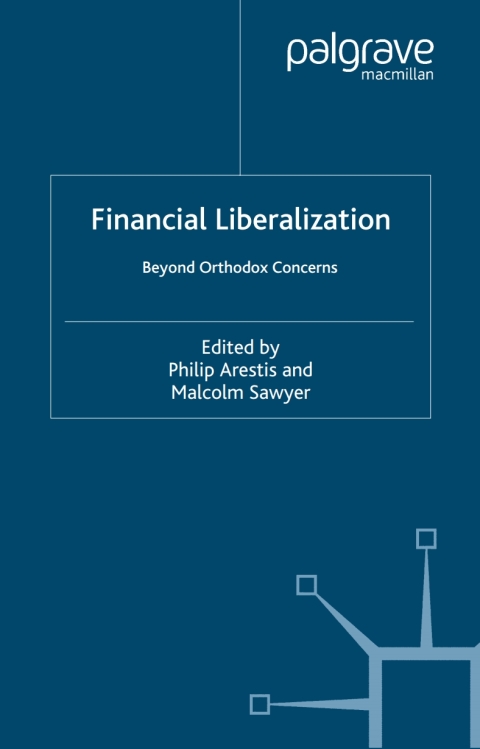
Financial Liberalization
P. Arestis
M. Sawyer
The financial liberalization thesis emerged in the 1970s and has been of considerable importance ever since, not merely in terms of its theoretical influence but, perhaps more importantly, in terms of its impact on policy makers and policy debates. Although it has encountered increasing scepticism over the years, it nevertheless had a relatively early impact on development policy, which still continues unabated, through the work of the IMF and the World Bank. The latter two institutions, perhaps in their traditional role as promoters of what were claimed to be free market conditions, were keen to encourage financial liberalization policies as part of more general reforms or stabilization programmes. This book explores what we have learned from the vast experience of the theoretical and policy aspects of the financial liberalization.
Economic Policy, General, Macroeconomics, Economic Conditions, General, Finance, Economics, Social Sciences -> Political Science -> Public Policy, Social Sciences -> Political Science -> International Relations & Foreign Policy, Business & Economics -> Economics -> Principles of Macroeconomics, cs.soc_sci.poli_sci.polit_ecn, Business & Economics -> Economics -> Economic Development, SCW34010, SC912000, SCW32000, SC912140, SCW42000, SUCO41136, 3032, 2881, 4662, 3031, Business & Economics -> Finance -> Finance - General, Business & Economics -> Economics -> International Economics, 7020, 8088
| Name in long format: | Financial Liberalization Beyond Orthodox Concerns |
|---|---|
| ISBN-10: | 0230522386 |
| ISBN-13: | 9780230522381 |
| Book pages: | 408 |
| Book language: | English |
| Edition: | 1 |
| Binding: | eBook |
| Publisher: | Springer Nature |
| Dimensions: | eBook |